
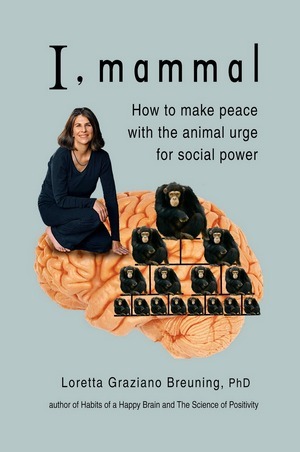

Animals compete for food and mating opportunity because their brain rewards them with a good feeling when they prevail. We have inherited the brain structures that motivate this. Nice people don’t talk about the animal urge for social power, but the impulse is harder to manage if you don’t know where it comes from.
The mammal brain rewards you with serotonin when you have a moment of social dominance. This is not what you’ve heard about serotonin, but the research is fully explained in this book.
A mammal’s brain constantly compares itself to others, and releases the good feeling of serotonin when it sees itself in the position of strength. Cortisol is released when a mammal sees itself in the position of weakness. This is why we humans spend our days comparing ourselves to others and reacting with strog feelings.
Serotonin create the nice relaxed feeling that it’s safe to act on the urge to asserts yourself. Cortisol creates the feeling that your survival is threatened unless you pull back. Mammals rarely fight because they’re so good at predicting who would win and they pull back as needed.
We humans are eager to do things that spark our serotonin and relieve our cortisol. But how?
Our mammalian limbic system is wired by early experience, so whatever sparked your serotonin in youth wired you to seek good feelings by repeating behaviors related to that. What sparked your cortisol in youth wired you to fear things related to that.
Serotonin is quickly metabolized, so you always have to do more to get more. This is why find ourselves repeating behaviors that sparked it before, despite our best intentions.
The result is many forms of “junk status.” This book helps you understand the curious things we do for serotonin. It shows you how to make peace with your inner mammal to feel good without an endless quest for the one-up position and an endless fear of the one-down position.
Social dominance helps an animal spread its genes, so natural selection built a brain that rewards you with good feelings when you do things that help spread your genes. We are not consciously trying to spread our genes, but animals aren’t either. We are all just trying to feel good and avoid feeling bad.
Nice people can’t admit that they enjoy the feeling of social dominance, but our non-verbal mammal brain works this way whether or not your verbal human cortex approves. The appetite for social power is as natural as the appetite for food and sex.
Social comparison will always be a thing. Our brain will always seek respect and attention as if your life depends on it because that helped our ancestors survive. Each brain longs to be special in a world where 8 billion others long to be special.
If you get upset about other people’s quest for social power, you will always be upset. Instead, you can learn to notice the impulse in yourself and redirect it. You can let go of junk status and shift toward new ways of satisfying your mammalian needs. This book shows you how.
Nothing is wrong with you. Nothing is wrong with us. We are mammals. We work hard to restrain these urges, and we can celebrate how well we do with the mental equipment we’ve got instead of focusing on our flaws.
Our verbal brain struggles to make sense of the ups and downs that take hold of us. We have so many words for this impulse: ego, competitiveness, pride, respect, one-upping, self-confidence, attention-seeking, social dominance, arrogance, social-climbing, assertiveness, manipulative, ambitious, oppositional. We use nice words for the impulse in people we like, and negative words for the impulse in people we don’t like.
It’s not easy being a big-brained mammal! Life makes sense once you understand the mammal brain. This book helps you build your power over this natural impulse instead of letting it make you miserable. You can wire yourself to stimulate serotonin without being a “jerk.” What a relief!
ISBN-13 : 978-1941959008 ASIN: B01M8EZT3Z
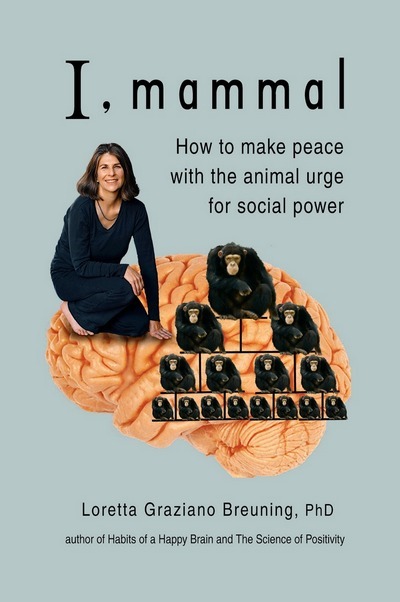
I, Mammal: How to make peace wtih the animal urge for social power

Animals compete for food and mating opportunity because their brain rewards them with a good feeling when they prevail. We have inherited the brain structures that motivate this. Nice people don’t talk about the animal urge for social power, but the impulse is harder to manage if you don’t know where it comes from.
The mammal brain rewards you with serotonin when you have a moment of social dominance. This is not what you’ve heard about serotonin, but the research is fully explained in this book.
A mammal’s brain constantly compares itself to others, and releases the good feeling of serotonin when it sees itself in the position of strength. Cortisol is released when a mammal sees itself in the position of weakness. This is why we humans spend our days comparing ourselves to others and reacting with strog feelings.
Serotonin create the nice relaxed feeling that it’s safe to act on the urge to asserts yourself. Cortisol creates the feeling that your survival is threatened unless you pull back. Mammals rarely fight because they’re so good at predicting who would win and they pull back as needed.
We humans are eager to do things that spark our serotonin and relieve our cortisol. But how?
Our mammalian limbic system is wired by early experience, so whatever sparked your serotonin in youth wired you to seek good feelings by repeating behaviors related to that. What sparked your cortisol in youth wired you to fear things related to that.
Serotonin is quickly metabolized, so you always have to do more to get more. This is why find ourselves repeating behaviors that sparked it before, despite our best intentions.
The result is many forms of “junk status.” This book helps you understand the curious things we do for serotonin. It shows you how to make peace with your inner mammal to feel good without an endless quest for the one-up position and an endless fear of the one-down position.
Social dominance helps an animal spread its genes, so natural selection built a brain that rewards you with good feelings when you do things that help spread your genes. We are not consciously trying to spread our genes, but animals aren’t either. We are all just trying to feel good and avoid feeling bad.
Nice people can’t admit that they enjoy the feeling of social dominance, but our non-verbal mammal brain works this way whether or not your verbal human cortex approves. The appetite for social power is as natural as the appetite for food and sex.
Social comparison will always be a thing. Our brain will always seek respect and attention as if your life depends on it because that helped our ancestors survive. Each brain longs to be special in a world where 8 billion others long to be special.
If you get upset about other people’s quest for social power, you will always be upset. Instead, you can learn to notice the impulse in yourself and redirect it. You can let go of junk status and shift toward new ways of satisfying your mammalian needs. This book shows you how.
Nothing is wrong with you. Nothing is wrong with us. We are mammals. We work hard to restrain these urges, and we can celebrate how well we do with the mental equipment we’ve got instead of focusing on our flaws.
Our verbal brain struggles to make sense of the ups and downs that take hold of us. We have so many words for this impulse: ego, competitiveness, pride, respect, one-upping, self-confidence, attention-seeking, social dominance, arrogance, social-climbing, assertiveness, manipulative, ambitious, oppositional. We use nice words for the impulse in people we like, and negative words for the impulse in people we don’t like.
It’s not easy being a big-brained mammal! Life makes sense once you understand the mammal brain. This book helps you build your power over this natural impulse instead of letting it make you miserable. You can wire yourself to stimulate serotonin without being a “jerk.” What a relief!
Free resources about I Mammal are available here

Top reviews
This is a great book in order to gain deeper perspectives to our feelings and thoughts. I was able to make sense of many of the behaviours I observe both in myself and others. As a person in love with behavioral neuroscience, I really enjoyed connecting the dots between us as homo sapiens and our ancestors.
Awesome! Thank you, Thank you, Ms. Breuning! Ms. Breuning’s insights expressed in “I, Mammal” are on par with the most influential evolutionary psychologists. Progress in psychology and related fields have been sorely slow and excessively abstract with limited practicality.
It is a great entry gate to topics such as “what makes us happy”, because it is scientific, it explains our biology and gives a direct approach to the question : culture vs nurture. It goes even further by saying : both and none.
Top reviews
This is a great book in order to gain deeper perspectives to our feelings and thoughts. I was able to make sense of many of the behaviours I observe both in myself and others. As a person in love with behavioral neuroscience, I really enjoyed connecting the dots between us as homo sapiens and our ancestors.
Awesome! Thank you, Thank you, Ms. Breuning! Ms. Breuning’s insights expressed in “I, Mammal” are on par with the most influential evolutionary psychologists. Progress in psychology and related fields have been sorely slow and excessively abstract with limited practicality.
It is a great entry gate to topics such as “what makes us happy”, because it is scientific, it explains our biology and gives a direct approach to the question : culture vs nurture. It goes even further by saying : both and none.
You may also interested in

Status Games
Why we play and how to stop
People seek status because animals seek status, and we've inherited the brain system that does this. It rewards you with serotonin when you see a way to raise your status, and alarms you with cortisol when you see a threat to your status. When you understand these ups and downs, you can rewire them. This book makes it fun.
The Science of Positivity
Stop negative thought patterns by changing your brain chemistry
Negativity is natural because our brain evolved to scan for threats. Past frustrations wired your brain to find new frustrations. You can rewire yourself to find positives to balance this natural negativity. You can do it in 6 weeks with just 3 minutes a day, no matter where you are in life. You will train your brain to find the good as skillfully as it now finds the bad.
You may also interested in
Status Games
Why we play and how to stop