
Serotonin
I’m top dog
Key Takeaways on Serotonin
- Serotonin turns on when you see yourself in a position of strength. It’s not aggression but a calm, confidence in your ability to meet your needs in a world full of rivals.
- Serotonin turns on in short spurts that are soon metabolized, so you are motivated to keep finding a position of strength to spark more. No one has an endless effortless flow.
- Neurons connect when serotonin flows, so whatever raised your social dominance in your past sparks the feeling more easily today. When you want to feel good, you flow there without conscious intent.
- The biggest neural pathways are built in youth, so your early moments of social dominance wired the way you seek it today. Mirror neurons play a role as a young person observes and mirrors behaviors that raise social importance.
- The brain habituates to rewards it already has, so new and improved social recognition is what really sparks it.
- Brain serotonin is separate from gut serotonin. They’re connected in nature because social dominance motivates an animal to reach for a piece of food and prepare to digest it.
What Is the Natural Job of Serotonin?
A monkey’s serotonin turns on when it sees itself in a position of strength. Monkeys compare themselves to others constantly because the stronger individual will dominate any resource they encounter. When a monkey sees that it’s weaker than the individual next to it, cortisol is released and it pulls back to avoid getting hurt. When it sees that it’s stronger, serotonin is released and it asserts itself. The feeling is not aggression but a calm confidence in your ability to meet your needs. This is not what you’ve heard about serotonin, so here’s the research.
Our digestive system has a lot of serotonin, but it doesn’t cross the blood-brain barrier. Your emotions come from the serotonin in your brain, but it’s useful to know how the two systems work together. When a monkey sees itself in the position of strength, serotonin allows it to relax into the urge to grab a piece of food and prepares the digestive system to receive the food. Serotonin is not meant to be on all the time. If it were, it couldn’t do its job of responding appropriately to the immediate situation. A monkey would get killed and eliminated from the gene pool if it went around believing it was in the position of strength when it wasn’t. We have inherited a brain designed to make realistic social judgments.
What Triggers Serotonin Today?
Modern human culture condemns the natural urge to enjoy a position of strength, so it’s hard for our conscious brain to acknowledge it. In the past, social dominance came from physical strength and a large family size. Today, moral superiority is the approved path to the one-up feeling. Appearance plays a big role too. Our brain keeps comparing and reacting chemically because we’ve inherited it from ancestors who succeeded in the survival game.
How Can A Person Get More Serotonin?
Serotonin is released in short spurts that are quickly metabolized, so we look for more social recognition to keep feeling it. To make matters worse, the brain habituates to rewards it already has, so it takes new and improved social recognition to really spark your serotonin. This is frustrating, but it’s nature’s operating system. When you know that everyone else has the same frustration, you can stop taking it so personally and just relax. You can even feel superior about your insight into the serotonin facts of life! (That was a shameless appeal to your urge for social dominance.)
If you don’t know the truth about serotonin, this is hard to do. So why are these facts not widely communicated?
– Much of our information about serotonin comes from the pharmaceutical industry. It funds the academic research as well as the media distibution of information on serotonin.
– Research on monkeys was attacked by violent activists in the late 1990s, and suddenly this whole field of research disappeared.
This makes it hard to notice your own serotonin responses. You keep flowing into the serotonin pathways built when you were young without conscious intent. You can build new serotonin pathways by feeding your brain new inputs about social comparison. All of my books and resources tell you how.
Where Can I Learn More About the Natural Job of Serotonin?
For most of human history, people could observe the conflict between animals for themselves. Today, we only see pets, who do not use their brain to find food and reproduce as it was designed to do. But researchers started to study the social dynamics of mammals about a century ago. The serotonin link to social dominance behavior was studied by the US National Institute of Mental Health, as reported in the New York Times. I explain these facts in my books: Why You’re Unhappy: Biology vs Politics, Status Games: Why We Play and How to Stop and I, Mammal: How to Make Peace With the Animal Urge for Social Power. For a list of studies on this, see my empirical research page. For books on the topic, see my reading list. To see the animal quest for social dominance for yourself, watch this fun monkey video, and this amazing video of kangaroo conflict. Here’s another on social hierarchy in monkeys. And another. See my blog posts and on the subject below, plus a 1-minute excerpt from my series, Love Chemicals.
Serotonin and Romantic Love – in 1 minute. Credit: Convicts
How to Get Real with Serotonin
I am not saying we should seek social dominance. I am saying we do, and we can manage this impulse if we are honest about it. We have inherited a brain that compares itself to others to promote its survival. It creates has a sense of urgency about how it measures up. If you don’t know you are creating this feeling yourself, you think the world is doing it to you. You feel bitter, resentful, and victimized. Instead, you can accept that the people around you are mammals, and you are a mammal too.
Mammals live in groups for protection from predators, but group life is frustrating. Every time a mammal sees a resource, a group mate sees it too. A little monkey gets bitten if it reaches for a fruit near a bigger monkey. Cortisol wires it to think twice before it asserts toward a resource. But hunger motivates it to search for an opportunity to be in the position of strength, and serotonin rewards a success.
We humans have many words for the serotonin feeling because it is so important to us. We call it pride, ego, confidence, assertiveness, competitiveness, arrogance, one-upping, status, power, importance, prestige, dominance, manipulativeness, being special, winning, feeling superior, dignity, saving face, and getting recognition, respect, approval, or attention. We favor the negative words when we see this urge in others, especially those we don’t like. When we seek social dominance ourselves, we justify it as a response to the dominance-seeking of others, we use positive language, or we simply refuse to acknowledge this impulse in ourselves.
Small-brained mammals have simple social rivalries. Large-brained primates often have complex social hierarchies. Animals like baboons and chimpanzees invest heavily in efforts to rise in their social hierarchy, and this helps to spread their genes. Our genes are inherited from individuals who asserted themselves successfully. We do it in individual ways, but we all crave social advancement because our brain makes it feel good.
Serotonin evolved to motive survival behavior, not to make you feel good all the time for no reason. There is no royal road to serotonin. The more social power a mammal has, the more it is challenged by rivals. Finding healthy ways to stimulate it is the challenge that comes with the gift of life.
My 5-day Happy Chemical jumpstart has a simple introduction to each of the happy chemicals in one email each – sign up for it and my newsletter in the footer below. Get the full story in my book Habits of a Happy Brain: Retrain your brain to boost your serotonin, dopamine, oxytocin and endorphin levels. All of my books help you notice your old serotonin pathways and then design and build a new pathway that leads to more happiness.
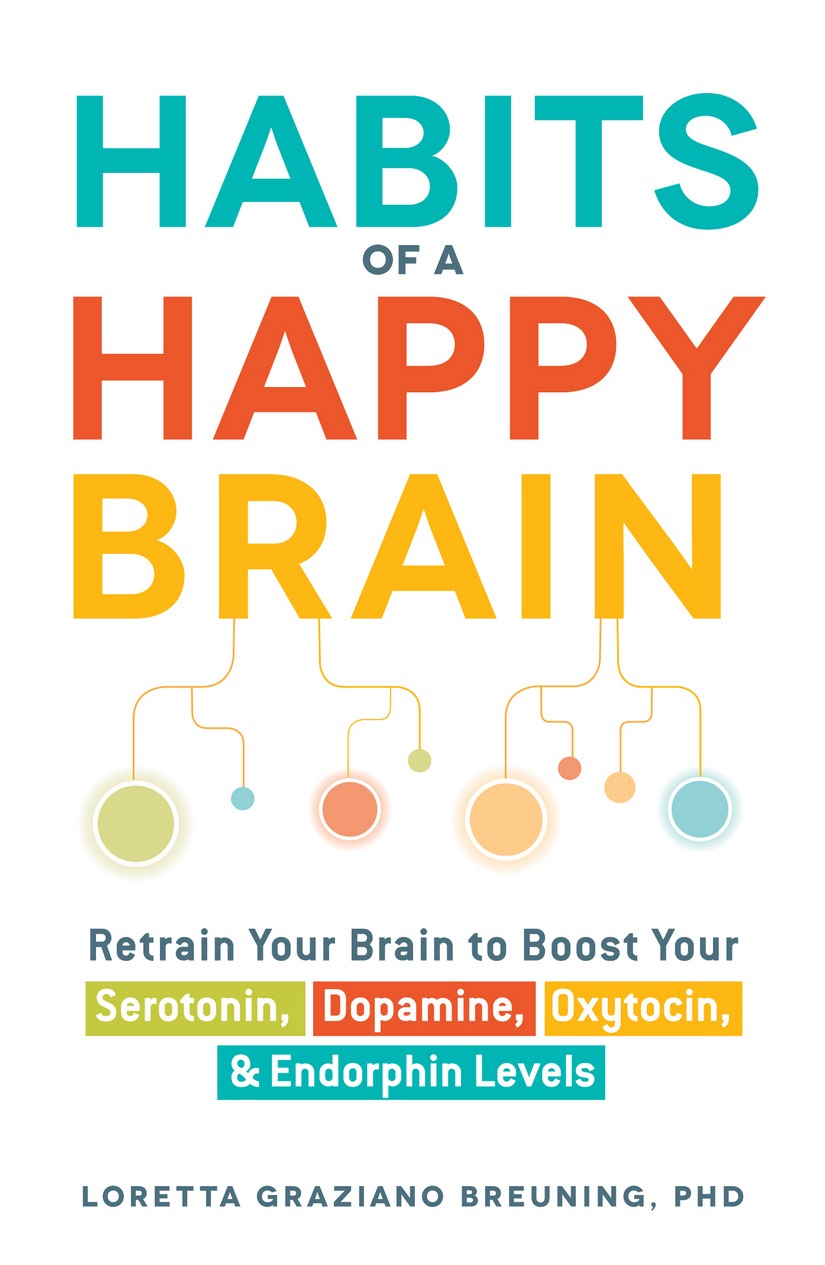
Habits of a Happy Brain
Retrain your brain to boost your serotonin, dopamine, oxytocin
Your happy chemicals are inherited from earlier mammals. When you know how they work in the state of nature, you can design sustainable ways to turn them on today. Here’s a plan to do it in 45 days, tailored to your unique brain. You can free yourself of unwanted habits and find healthy ways to enjoy dopamine, serotonin, oxytocin and endorphin.
Habits of a Happy Brain
Retrain your brain to boost your serotonin, dopamine, oxytocin
Your happy chemicals are inherited from earlier mammals. When you know how they work in the state of nature, you can design sustainable ways to turn them on today. Here’s a plan to do it in 45 days, tailored to your unique brain. You can free yourself of unwanted habits and find healthy ways to enjoy dopamine, serotonin, oxytocin and endorphin.